
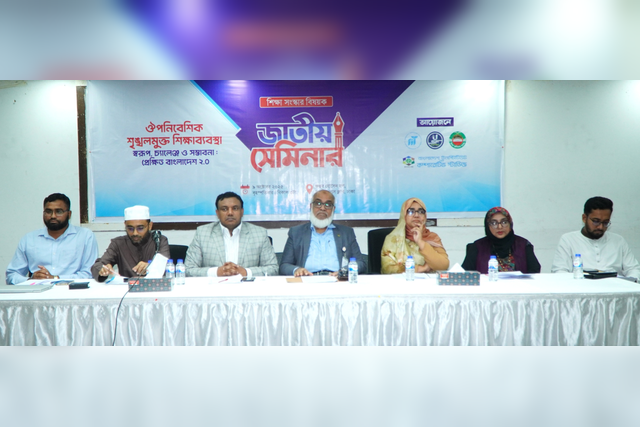
National Seminar on Education Reform: A Decolonized Education System Is one of the Key Demands of the July Revolution
Speakers at a national seminar on education stated that a radical reform of the education system, free from colonial shackles, is essential to fulfill the July Revolution and implement its spirit in society. According to them, Bangladesh’s education structure remains trapped in colonial thinking and a mentality of subjugation.
They argued that structural and philosophical transformation of the education system is now a pressing necessity if the nation is to become self-reliant and stand with dignity on the global stage. However, they expressed regret that although several commissions were formed after the July Revolution to reform the state, no commission was established for education reform, which they described as a failure of the government.
The national seminar titled “A Decolonized Education System: Nature, Challenges and Possibilities — Bangladesh 2.0 Perspective” was held on Thursday, 9 October 2025, at 3:00 PM at the Zahur Hossain Hall of the National Press Club. The event was organized by the Dhaka-based research organization Research and Integrated Thoughts (RIT), the Bangladesh Institute of Comparative Studies, Shikkha Odhikar Sangsad, and the University Study Forum.
The keynote paper was presented by Dr. Tarek Mohammad Zayed, Research Fellow at INTI International University, Malaysia. He stated, “Bangladesh’s education framework still carries the legacy of Macaulay’s education policy, where education has been shaped more toward employment than self-identity. The purpose of education should be to create opportunities for independent thinking and the development of creativity.”
He further said, “Intervention is necessary to transform the education system. Reform is urgently needed at three levels—macro, meso, and micro. At the government level, a flexible curriculum must be developed, education universities should be established, and classroom practices should place greater emphasis on ethics and psychological development.”
He added, “Alongside land, labor, capital, and organization, morality is the fifth pillar of development. The education system must integrate the three domains—cognitive, affective, and psychomotor.”
In his presidential address, Professor Dr. Mohammad Ismail, Vice-Chancellor of Noakhali Science and Technology University, said, “Education is not merely about profession or employment; it is a process of cultivating freedom of thought, humanity, and a sense of justice. If we want to build a free society, the soul of education must be decolonized.”
The seminar was moderated by Dr. Ekram Uddin Suman. Panel discussants included Professor Dr. Syeda Sultana Razia, Member of the National Curriculum Coordination Committee; Professor Dr. Mohammad Mahfuzur Rahman, Pro-Vice-Chancellor (Education), Jahangirnagar University; Dr. Kh. M. Kabirul Islam, former Senior Secretary; Professor Dr. Nazmun Nahar, North South University; Nurul Islam Saddam, Secretary General, Bangladesh Islami Chhatra Shibir; Muhammad Raihan Ali, President, Bangladesh Islami Chhatra Majlis; Abu Sadiq Kayem, Vice President, DUCSU; Mazharul Islam, General Secretary, JAKSU; and Md. Burhan Uddin Noman, Executive Director, Institute of Innovation in Policy and Development (IIPD).
The speakers observed that the colonial education system has kept the nation mentally enslaved in thought and values. Panel discussant Mosharraf Hossain said, “The education system introduced by the British has produced more than ten million educated unemployed people in this country—this is the result of the failure of the state’s education policy.”
Professor Dr. Nazmun Nahar said, “The number of educational institutions in our country is increasing, but their quality is declining. The lack of honesty and morality among teachers is also affecting the intellectual development of students. Without development-oriented and humane education, social transformation is impossible.”
Muhammad Raihan Ali said, “An education system that is fragile and devoid of morality cannot produce skilled and honest citizens. Adequate budget allocation must be ensured for the education sector, and technology-based, career-oriented education must be established.”
Nurul Islam Saddam said, “Today’s generation is collapsing morally—and the reason is the lack of values and responsibility in the education system. These issues must be prioritized in the new education policy.”
Md. Burhan Uddin Noman said, “Before the British period, education during the Sultanate and Mughal eras was society-centered and humane. Colonial education destroyed that framework, resulting in learning loss and organizational stagnation.”
Mazharul Islam said, “An education system that is not connected to the real needs of society can never play a role in nation-building. Education must be reconstructed through the integration of policy, character, and skills.”
The speakers further stated that, just as administrative and political reforms became necessary after the July Revolution, it is equally urgent to form a national commission for education reform. They warned that if education reform is delayed, the colonial structure will continue to control the mentality of society and the state.
Distinguished educators, researchers, university students, and representatives of civil society from across the country attended the seminar. In the view of the speakers, “If education is not free, society cannot be free either.”
On behalf of the organizing institutions, it was announced that as part of this continuing initiative, regional seminars and research publications will be organized at various universities across the country in the coming months.