
Offshore Gas: Theft abroad or failure at home?
A claim is moving from social media chatter into mainstream discussion: Bangladesh’s gas, it is said, is being stolen from beneath the Bay of Bengal. The fear is easy to understand. People watch India and Myanmar produce offshore oil and gas on either side of our waters while Bangladesh keeps importing expensive LNG and leaves its own sea largely untested. Before dismissing the rumour, it is worth asking why it sounds believable to so many.
Start with one comparison. In five decades, Bangladesh has drilled about a hundred wells in search of gas. India drilled 545 in a single year. On the Indian side of the maritime line, oil began flowing from a deep-water field in early 2024. Off the Rakhine coast, Myanmar has produced gas since 2013 and pipes much of it to China. Neither neighbour found this easy. Both spent years, took risks, and paid for data and wells. But both eventually moved from paperwork to rigs and platforms at sea. On our side, the sea is quiet. These are waters Bangladesh won fair and square, against Myanmar at an international tribunal in 2012 and against India in 2014. Yet today the country has not a single producing offshore gas well. So the honest question is not first whether someone is stealing our gas. It is why Bangladesh has failed to turn legal victory into steady offshore production since the Sangu field ran dry.
The uncomfortable answer begins at home. For the 2025-26 fiscal year, Petrobangla reportedly set aside roughly Tk 580 billion to import LNG, while the money for finding our own gas was only about Tk 11 billion. That is a gap of about fifty to one. Imported LNG is also far costlier than local gas, and in 2024-25 the import bill crossed Tk 407 billion even as domestic output kept falling. This is not a geological mystery alone. It is a policy choice. A gap that wide is not a foreign conspiracy. It is the difference between an exploration effort that kept drilling and one that did not.
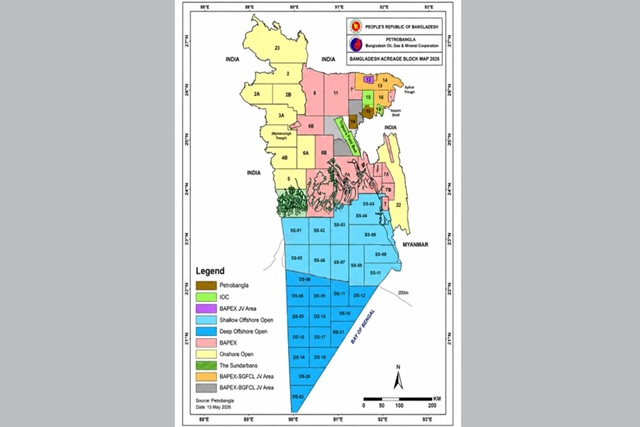
Idleness, though, is a symptom rather than a cause, and the cause has a paper trail. After winning its maritime boundaries, Bangladesh leased two promising shallow-water blocks, SS-04 and SS-09, to a consortium led by India’s ONGC Videsh and Oil India in 2014. The blocks remained with that consortium for more than a decade, and the contract was extended three times. Only one well, Kanchan-1, was drilled, and it did not show commercially viable gas. In February 2025, after the remaining work commitments were not completed, Petrobangla invoked the companies’ bank guarantees. The Indian firms then exited, having written off tens of millions of dollars.
This record should not be treated as a routine business disappointment. A foreign consortium held strategically important Bangladeshi acreage for fourteen years, failed to deliver a commercial discovery, did not complete the promised work programme, and left. That does not, by itself, prove cross-border theft or a sabotage plot. But it does raise serious questions. Why were promising offshore blocks allowed to remain tied up for so long? Whose interests were served by repeated extensions and weak enforcement? Were there only commercial misjudgements, or were there political calculations, undue influence or corruption that kept Bangladesh behind? These questions deserve investigation. They also explain why many citizens now ask whether Bangladesh’s gas is being taken from outside, or whether the country was deliberately kept from testing and developing its own side of the sea. Either way, the outcome was the same: lost time, lost data and no offshore production.
Nor was this an isolated failure.Santos of Australia, ConocoPhillips of the United States and South Korea’s Posco-Daewoo also walked away, the last after seismic work indicated potential but before drilling, amid disputes over pricing and terms.The wider pattern shows that Bangladesh’s offshore problem cannot be reduced to one company or one country.Still, the Indian-led blocks matter because they sit at the centre of the public suspicion: India developed offshore resources on its own side while an Indian-led consortium delivered no producing result on Bangladesh’s side.That contrast is not evidence of cross-border extraction.It does, however, justify hard questions about contract design, state oversight, political bargaining and the cost of delay.
The failed 2024 offshore round made the same point at the system level. The government offered 24 offshore blocks. The geology drew real interest. Seven companies bought bid documents, and majors such as ExxonMobil and Chevron reviewed the data. Then not one placed a bid. They had studied our seabed and judged the terms not worth the risk. Even with pricing moved toward Brent, the gas price was still seen as too low. Pipeline costs and tariffs remained a worry, a five percent workers’ profit levy sat on top, and the data package was too thin for a multibillion-dollar frontier decision.The point is not to replace the rumour with another one. It is to show how clauses, delays and policy choices made at home priced exploration out of reach.
The encouraging part is that this can be fixed, and some of the work has begun. Over the past year the terms were rewritten. Gas prices are now linked to Brent crude with a floor and a ceiling. The new model adds tax relief, a pipeline-tariff mechanism, a lighter levy and conditional export rights subject to Petrobangla’s first right of refusal. In May 2026, a fresh round for 26 blocks opened, with bids due by 30 November. But a better contract is not a working well. The test is no longer the wording on paper. It is whether the country can carry it all the way to a rig in the water.
Recent diplomacy also points in the right direction, but it should be read with caution. In Kuala Lumpur, Dhaka invited Malaysian firms into Bay of Bengal exploration and encouraged direct talks between Petronas and Petrobangla. In Beijing, the agenda covered connectivity and a proposed Bangladesh-Myanmar-China economic corridor. If realised, such a corridor could open new possibilities for regional connectivity, infrastructure and energy cooperation. But it would not, by itself, solve Bangladesh’s offshore gas problem. Any route through Rakhine would face a hard security reality: much of the state and the border with Bangladesh are now shaped by conflict, while China’s older Myanmar corridor has already faced years of delay and uncertainty. Other major powers would also watch such a route closely, because infrastructure through the Bay of Bengal is never only about trade or energy; it is also about strategic influence. The deals Bangladesh should chase, therefore, are those that bring competitive drillers into its own offshore blocks, not those that turn a difficult corridor into a substitute for exploration at sea.
China’s offshore capability is real, and Bangladesh needs partners with technology, capital and deep-water experience. Chinese firms should be part of that conversation if they compete on fair and transparent terms. The real issue is over-reliance on any single partner, whether Chinese, Western, Malaysian or Indian. In offshore energy, data, infrastructure and pricing terms can shape future choices.That is why every deal must preserve Bangladesh’s bargaining power through competition and transparency, starting with a clean, open tender that keeps Petronas, Chinese majors, ExxonMobil, Chevron and other credible operators in the race.Caution is necessary, but it should not become paralysis. Fourteen years of Indian-led blocks delivered nothing, and over-caution now risks losing another decade. There is also a quieter question: who benefits when domestic exploration stalls and imports grow? Imported LNG has built a large trading and regasification chain, while BAPEX, the national exploration company, remains underfunded and without offshore drilling experience. Whichever flag the company flies, what matters is a fair process that serves Bangladesh’s interest and moves quickly.
This brings us back to the rumour. The claim that India and Myanmar are quietly sucking Bangladesh’s gas across the boundary, draining our reserves as if with a vacuum, is not supported by geology or evidence. Gas can be drawn across a boundary only where one continuous reservoir crosses it. Repeating the vacuum version does not protect Bangladesh; it weakens the argument. But the anxiety underneath the rumour is not foolish. It is badly explained. Gas reservoirs do not respect political borders, and neighbouring discoveries matter. Myanmar’s Rakhine Basin to the east and India’s Mahanadi and Krishna-Godavari systems to the west show that gas-bearing petroleum systems sit on both flanks of our waters. That does not prove a shared reservoir. It does make Bangladesh’s failure to test its own blocks far harder to defend.
The real loss is not proven cross-border theft. It is strategic delay. Neighbours are proving reserves, producing gas and building markets while Bangladesh has not turned its maritime rights into a single producing well. When global gas was cheaper and offshore drilling looked costly, importing LNG may have seemed practical. Since 2018, however, that bet has become a vulnerability. A single year’s LNG import bill now runs past Tk 400 billion, and dependence turns dangerous whenever distant wars or shipping disruptions move the market. Even a fraction of that money, spent earlier on seismic work and drilling, could have left Bangladesh with more data, more bargaining power and a stronger supply position today.
The way forward is not mysterious. Finish the seismic surveys. Make the data package bankable. Hold bidders to firm drilling deadlines instead of repeating endless extensions. Give BAPEX the resources and partnerships it needs to become the national company it was meant to be. Turn winning bids into a dated drilling programme, not another file of promises. Bangladesh did not lose these waters. It won them. But sovereignty is not only a line on a map. It is the ability to explore, prove and use the resources that may lie within that line.The regional geology has already given Bangladesh enough reason to act. The only open question now is whether it can finally test its own side of the line.